Why ChatGPT recommends you one day and not the next
By Sviatoslav Stohov · AI Visibility Strategist · Published
ChatGPT recommends you one day and not the next because it doesn't keep a fixed list. Each time, it runs new web searches, reads a different set of pages and writes a new answer. When the pages change, the names can change too. In our data, the same question asked twice a few minutes apart usually shared fewer than half of its cited sites.
How much an answer changes in a few minutes
We asked ChatGPT the same question twice, a few minutes apart, 4,771 times. The questions were "best tool" questions for B2B companies, with no brand names. Then we compared the sites each pair of answers linked to.
Only 1.8% of the pairs cited exactly the same sites. In half of the pairs, no more than 42% of the sites matched. In 3.2%, the two answers had no site in common.
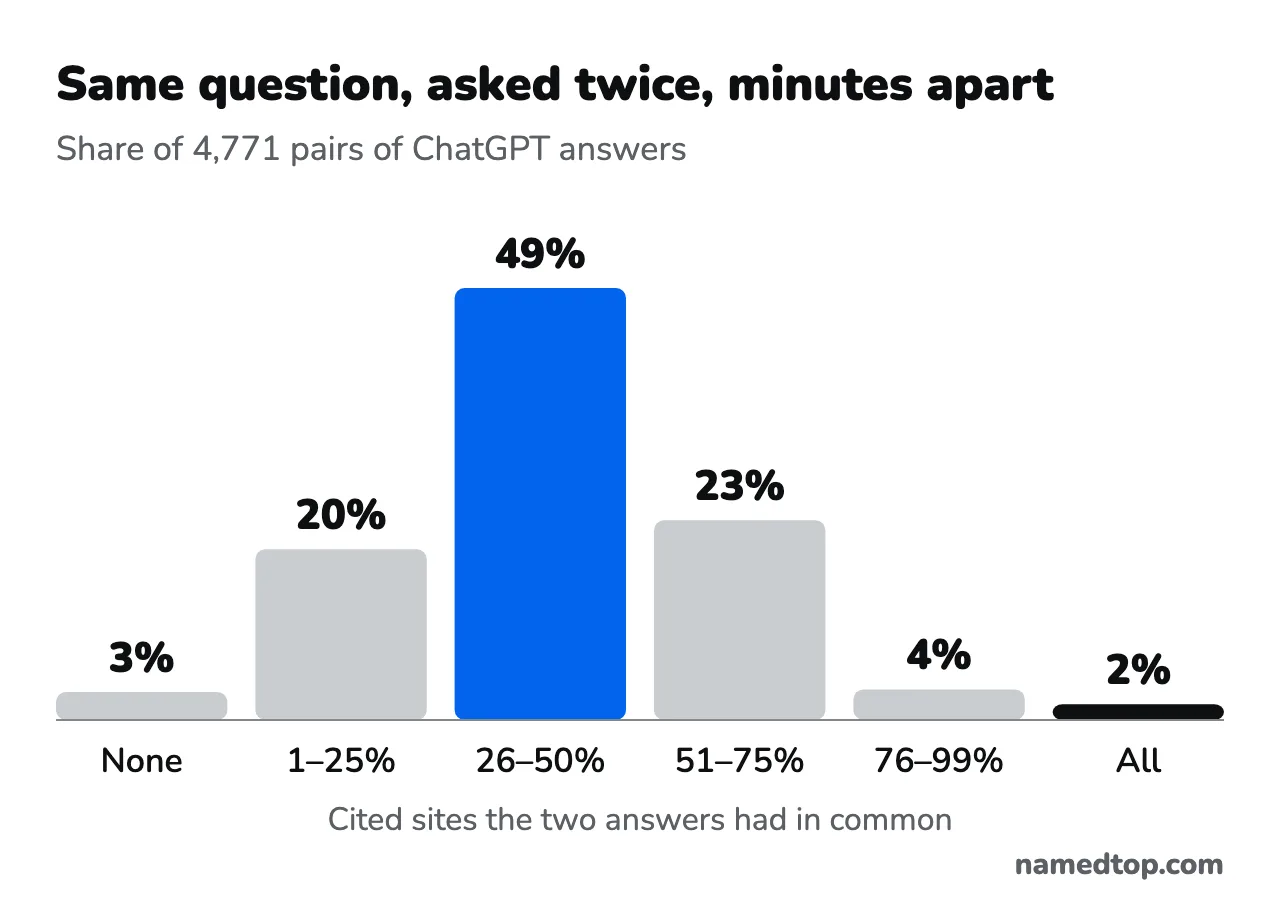
The sites behind an answer strongly shape which companies it names. When half the sites change, the list of names can change with them.
How much answers change from day to day
Over days, answers keep changing. Ahrefs, an SEO tool company, followed about 37,500 citations in five AI search products for 20 days. From one day to the next, 50–83% of the citations disappeared. About 75% of them came back within the 20 days (Ahrefs).
These are a vendor's own numbers, and we couldn't check them. They match what we see: a citation you see today may be gone tomorrow and back next week. Ahrefs itself advises against crediting a page edit for a single comeback.
Some assistants change more than others
On 31 October 2026, we asked three assistants five questions about AI visibility, then asked the same five questions again later the same day. We compared the sites each assistant cited the first and the second time.
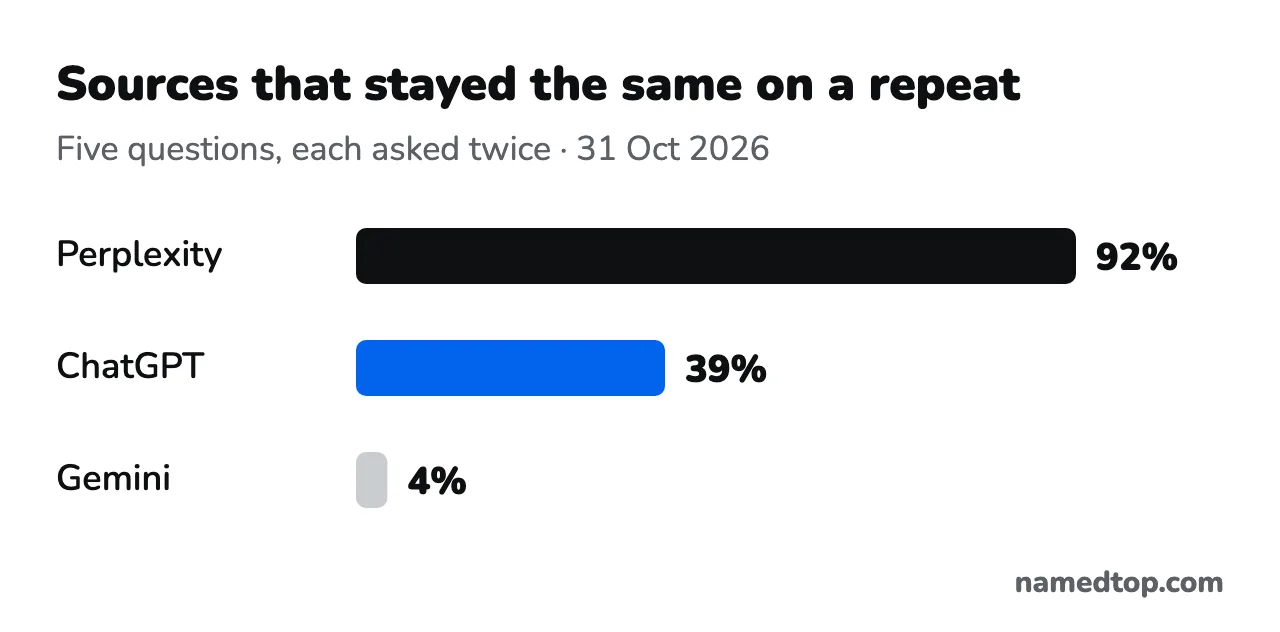
Perplexity kept almost the same sources. ChatGPT kept about two in five. Gemini changed almost all of them. This is a small test: five questions and one repeat. It shows which sites each assistant cited, not whether it named a particular company.
Why your own test and a tracker disagree
A tracking tool and your own test are two samples taken at different moments. The tool may ask from another country, with no account and no history. You may ask while logged in, with your own chats and memory. Each of you gets one answer out of many possible ones.
Neither result is wrong. Each is too small a sample to act on.
How to measure it properly
- Ask each question several times, not once. Count how often you are named: "named in 6 of 10".
- Keep each assistant separate. They read different pages and change at different speeds.
- Compare over weeks, not days. One good day is not a trend.
- Keep the date, the question and the assistant with every answer, so you can compare like with like.
- Use Bing Webmaster Tools. Its free AI Performance report shows how often Microsoft Copilot cites your pages.
What our free check does
In our free check, we ask 10 of your buyers' questions in six assistants. Where we find a gap, we ask the key questions again on that assistant: up to 10 times, or up to 5 on Claude and Grok. A finding goes into the email only when it holds in at least half of the runs. We don't change anything on your site, and the check is not a promise that assistants will name you.