How to check what ChatGPT says about your company
By Sviatoslav Stohov · AI Visibility Strategist · Published
To check what ChatGPT says about your company, ask it the questions your buyers ask, without your brand name, in a new chat with no history. Ask each question more than once, and ask the other assistants too. Then write down three things: whether you are named, who is named instead, and which pages the answer links to.
Don't ask about your brand by name
"What is Acme?" tests whether ChatGPT knows you. It doesn't tell you whether ChatGPT recommends you. Buyers don't ask about you by name: they ask for the best tool for their job.
So write the questions your buyers would ask. Describe the job, the type of company and the problem. Leave out every brand name, yours and your competitors'. In our free checks, we drop any question that still names a brand.
Start a new chat with no history
ChatGPT can use your earlier chats and saved memory. If you have talked to it about your company, it may name you because of that. Your buyer's ChatGPT has never seen those chats.
Use a temporary chat, or an account that has never talked about your company. Ask each question in a new conversation, so one answer doesn't shape the next.
Know what ChatGPT searches for
ChatGPT doesn't answer a buyer question from memory alone. In more than 9,400 answers to category questions, it searched the web before 99.7% of them. It wrote about two searches of its own per answer. It added the year "2026" to 45% of those searches and the word "best" to 31%.
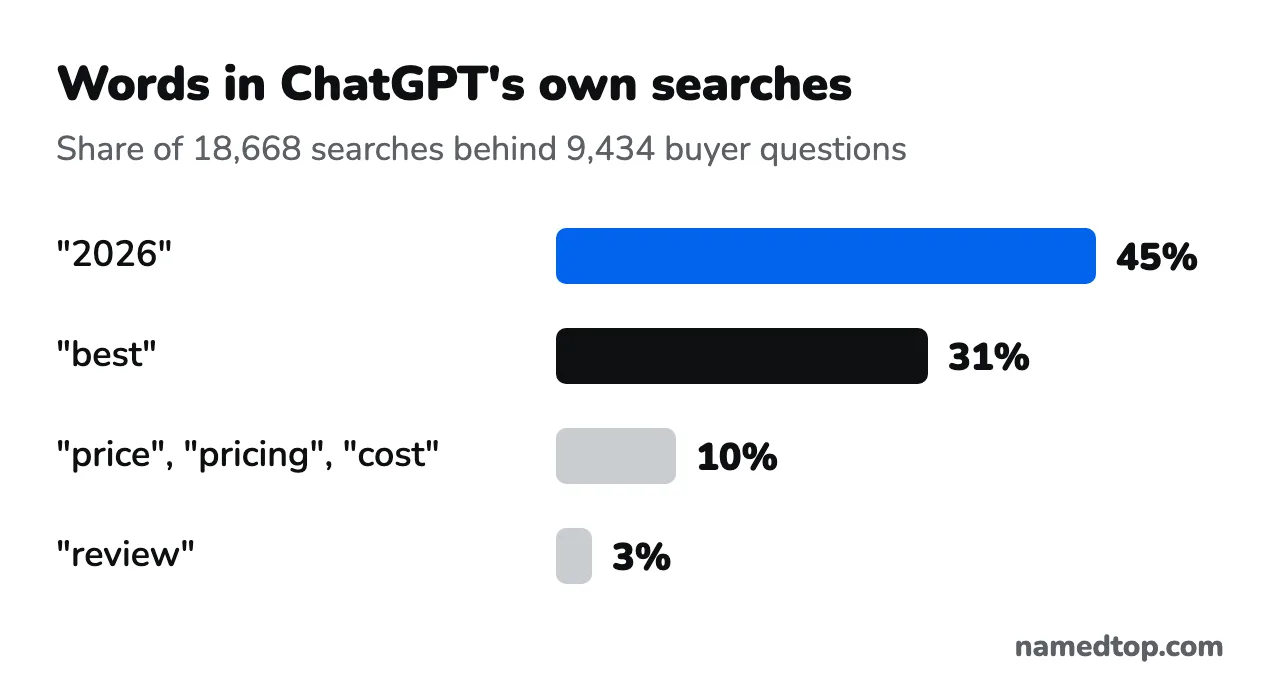
This tells you which pages ChatGPT is likely to find: fresh "best" lists and guides for your category. When you check an answer, open the pages it links to. They show you where ChatGPT got its list.
Ask more than once
One answer is a sample, not a verdict. We asked ChatGPT the same question twice, a few minutes apart, 4,771 times. The two answers cited exactly the same sites in only 1.8% of cases. Typically, fewer than half of the sites they cited were the same.
Ask each important question at least five times, on different days. Count how often you are named: "named in 2 of 5" tells you much more than one yes or no.
Check the other assistants too
Your buyers don't all use ChatGPT, and each assistant runs its own searches. A study of four AI search engines, ChatGPT, Copilot, Google and Perplexity, found that 96.4% of the links they showed for the same questions appeared in only one engine. It was a small study: 15 questions on one day (the study).
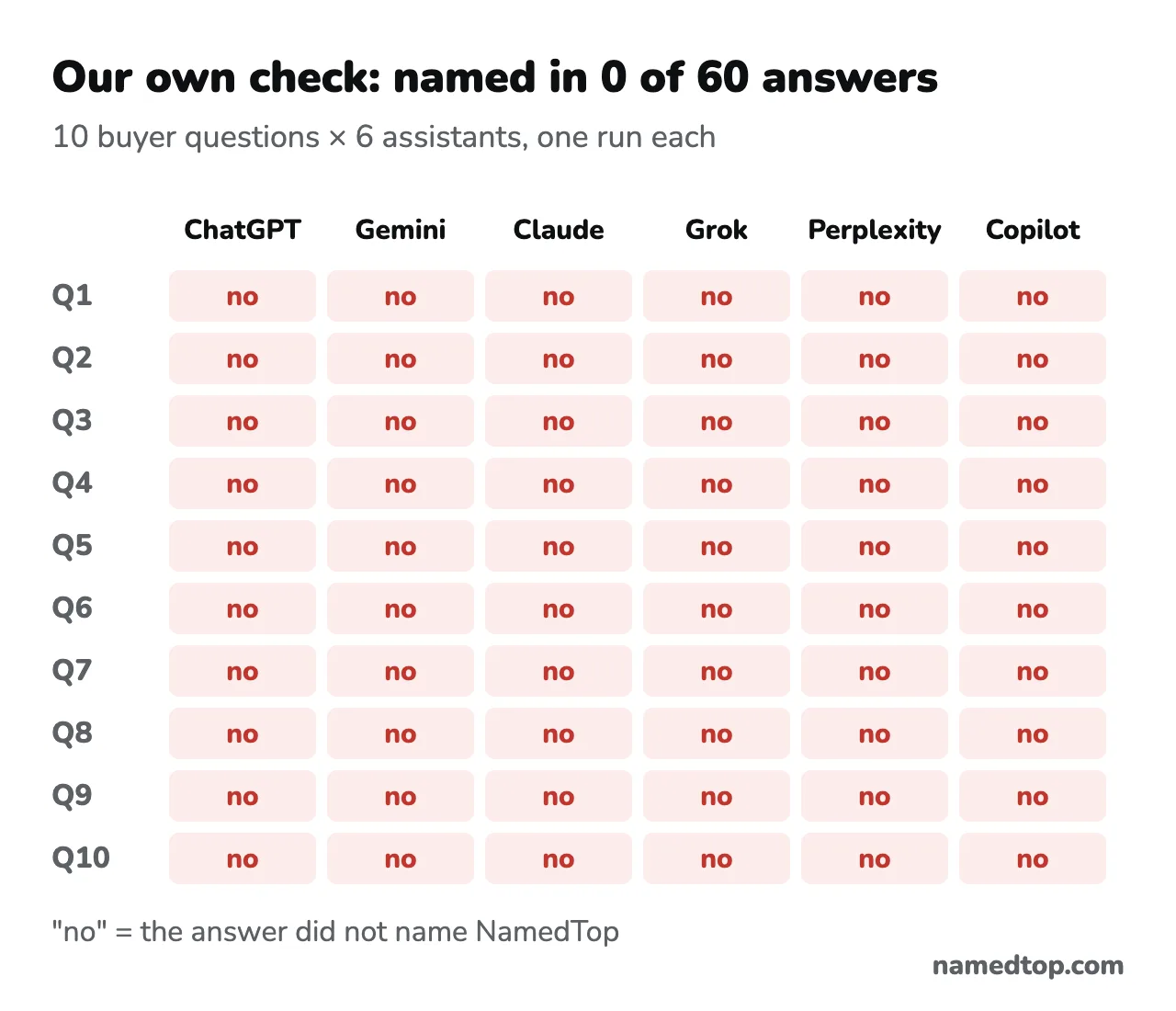
Here is what a check across all six assistants looks like. We ran it on our own company: 10 buyer questions, one run each.
What to write down
| What to record | Why it matters |
|---|---|
| The question, the assistant and the date | Answers change, so a result without a date can't be compared later |
| Whether you are named | This is the result you track over time |
| Who is named instead of you | These are the companies the assistant treats as your competitors |
| The pages the answer links to | These are the pages to check for your name |
| How you are described, if you are named | A wrong fact here can reach other buyers who ask |
Keep the answers in one sheet. When you change something, you can then compare before and after on the same questions.
What our free check does
Our free check does this for you. We pick 10 buyer questions from your site and your category, with no brand names. We ask each one in a new conversation in six assistants: ChatGPT, Gemini, Claude, Grok, Perplexity and Microsoft Copilot. Where we find a gap, we ask the key questions again: up to 10 times, or up to 5 on Claude and Grok. You get an email with what we found and the assistants' own words. We don't change anything on your site, and the check is not a promise that assistants will name you.